
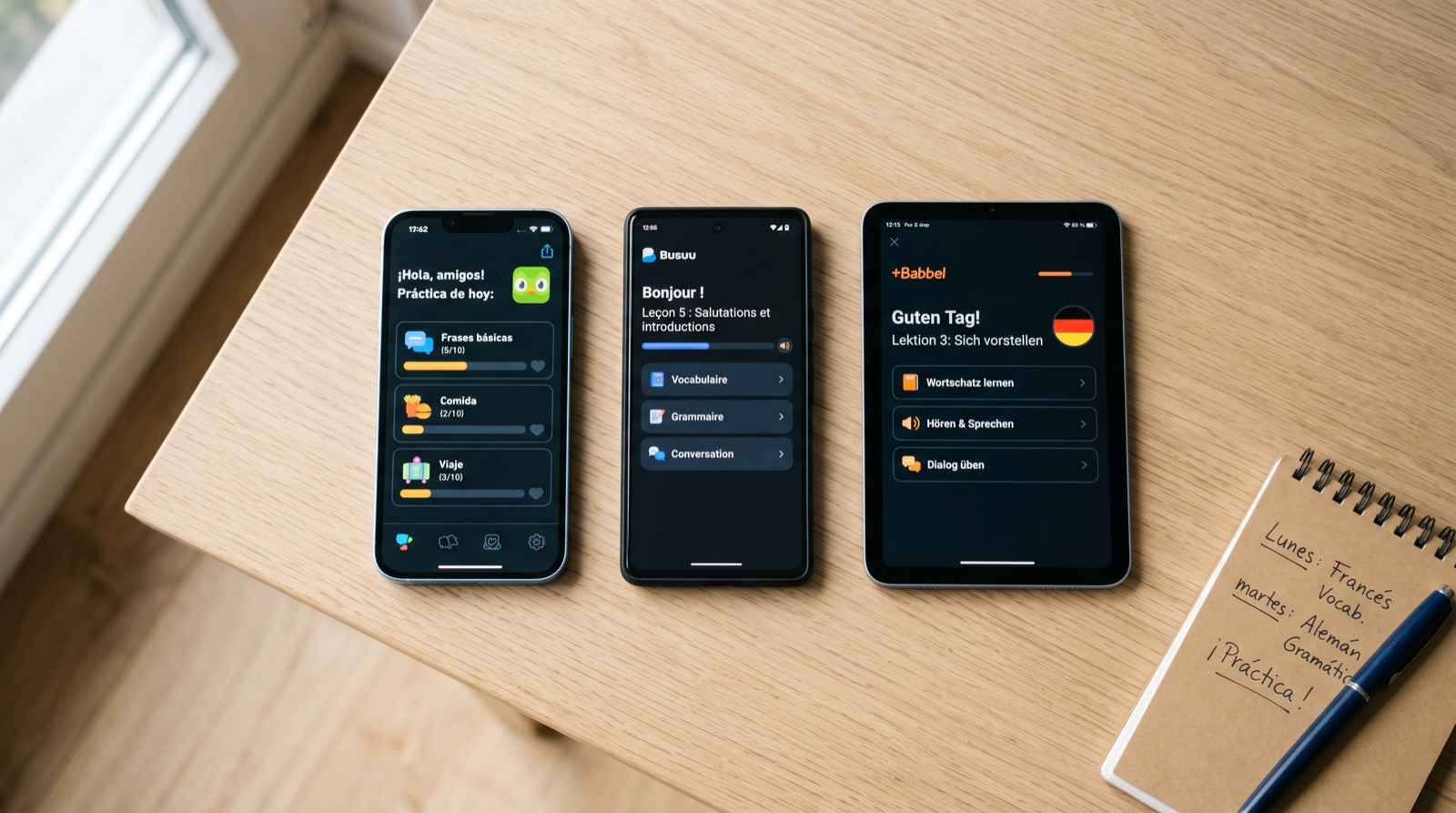
I used Duolingo for almost two years. By the end of it I could tell you the streak count of every friend I'd added, but I couldn't order a coffee in the language I'd supposedly been learning. That's a familiar story, and the comments on every "I quit Duolingo" Reddit post say the same thing: the gamification works on you, the learning doesn't really stick.
If you're reading this, you've probably hit the same wall. Maybe the lessons feel repetitive. Maybe the ads are wearing you down. Maybe you noticed the streak matters more to you than the actual vocabulary. Whatever brought you here, the good news is there are real alternatives in 2026, and most of them teach better than Duolingo does. The hard part is figuring out which one fits how you actually learn.
I've tried most of these. For the rest I've talked to enough people who use them daily that I trust what I'm passing on. Where an app is genuinely better than what I work on (Wordify, which I'll get to honestly), I'll say so.
What Duolingo is actually good at
Before tearing into the alternatives, it's worth being fair about Duolingo. It's free. The streak mechanic genuinely does keep some people coming back for years. The course catalog covers languages most apps ignore (Welsh, Navajo, Hawaiian). And for absolute beginners who've never tried to learn a language as an adult, the gentle on-ramp is real.
The problems start when you cross from "absolute beginner" to "wants to actually use the language." The lessons are shallow. The translations are often weird or context-free. The grammar explanations are skipped or buried. And the paid tier (Super Duolingo at €12.99/month) mostly buys you the absence of ads, not better learning.
So the question isn't "is Duolingo bad." It's "what are you trying to do, and is there a tool that does it better?"
1. Babbel
Best for: Structured beginners who want grammar explained properly.
Price: ~€12.99/month, often discounted.
Babbel is what Duolingo could be if it took adult learners seriously. The lessons are shorter (10-15 minutes), the grammar is explained in plain language, and the dialogues use the kinds of phrases you'd actually say in a conversation. The course is built by linguists rather than crowdsourced, which shows.
The trade-off is that Babbel's course catalog is narrow. You get 14 languages, all of them European or close to it. No Mandarin grammar deep dive, no Arabic, no anything south of the Mediterranean.
If you're a working adult who wants to be functional in Spanish or German in six months, this is probably the best paid option on the list. If you want to learn Japanese or Korean, look elsewhere.
2. Memrise
Best for: Vocabulary acquisition with native speaker video.
Price: Free tier exists. Pro is ~€8/month.
Memrise built its reputation on flashcards plus video clips of native speakers saying the words. The "MemBots" feature added in 2023 lets you have practice conversations with an AI in the target language, which works surprisingly well for low-stakes speaking practice.
What's missing is real grammar instruction. You'll learn that "yo quiero" means "I want," but Memrise won't really explain when to use ser vs estar or why subjunctive exists. It's strong on vocabulary and listening, weak on speaking and writing.
The free tier is genuinely usable, which puts it ahead of Duolingo's increasingly cramped free experience.
3. Anki
Best for: Serious learners who want maximum control.
Price: Free on desktop and Android. €29.99 one-time on iOS.
This is the spaced repetition flashcard system that almost every language learning YouTuber recommends. The algorithm (SM-2 and its descendants) is the best in the business for long-term retention. Decks exist for basically every language, and you can build your own or share with others.
The catch is that Anki is famously ugly and the learning curve is real. The interface looks like a research tool from 2008, because that's basically what it is. Setting up a good workflow takes a weekend. Once you've done it, you'll probably remember vocabulary better than with any other tool on this list.
If you're the type who reads about study techniques and watches Refold videos on YouTube, Anki is for you. If you'd rather just open an app and not configure anything, keep scrolling.
4. Pimsleur
Best for: Audio-first learners who want to speak from day one.
Price: ~€19.95/month or one-time course purchases.
Pimsleur is the oldest method on this list, and it's still good. The lessons are 30 minutes of audio, all of it focused on listening and speaking. You're prompted to respond out loud constantly, which forces you past the "I can read it but can't say it" wall that most app users hit.
The downside is price (it's the most expensive option here) and that you genuinely have to do the audio lessons. They don't work as background noise. If you commute and can use that time for focused listening, Pimsleur will get you speaking faster than anything else. If you wanted an app to fill three-minute waiting room slots, this isn't it.
5. Busuu
Best for: Learners who want feedback from native speakers.
Price: Free tier. Premium ~€9.99/month.
Busuu's distinguishing feature is the community. You write or record a short response to a prompt, and actual native speakers correct it. In return you correct learners studying your language. The exchange works because it's gamified just enough to keep both sides engaged.
The lesson content itself is fine, comparable to Babbel but slightly less polished. The reason to pick Busuu over Babbel is the corrections from real humans. If you're shy about speaking out loud but want feedback on your writing, this is the strongest option.
6. LingQ
Best for: Intermediate learners who want to learn through real content.
Price: ~€12.99/month for Premium.
LingQ takes a different approach: instead of teaching you, it gives you tools to read and listen to real content in your target language. You import articles, YouTube transcripts, podcasts, books, and the app helps you understand and track new vocabulary as you encounter it.
This is brilliant for intermediates who've outgrown beginner apps but aren't ready for native content unaided. It's painful for beginners, who need more structure than "here's an article, click words you don't know."
If you've finished a Duolingo tree and feel like you can't actually use the language, LingQ is probably the best next step.
7. Drops
Best for: Visual learners who want short daily sessions.
Price: Free tier limited to 5 minutes per day. Premium ~€10/month.
Drops is a vocabulary-only app built around beautiful illustrations and quick swipe interactions. Each session is gorgeous to look at, and the 5-minute daily limit on the free tier is actually a feature (it prevents burnout and reinforces consistency).
The course is purely vocabulary, no grammar at all. You'll learn what "el perro" is but not when to use the definite article. It's also expensive for what it is. The Premium tier costs the same as Babbel, which teaches you the whole language.
Worth trying free. Worth paying for only if you specifically want a pure vocabulary tool and the visual style works for you.
8. Mondly
Best for: Learners who want speech recognition that actually works.
Price: ~€9.99/month or €47.99/year, often discounted heavily.
Mondly's speech recognition is the best I've used in a consumer language app. The conversations are scripted, but the system genuinely listens to your pronunciation and gives meaningful feedback. The VR and AR modes are gimmicks, but the core speaking practice is solid.
The lesson content is uneven. Some courses are excellent, others feel like they were translated through a machine. Read recent App Store reviews for your specific language before committing.
9. FluentU
Best for: Learners who want to study through video.
Price: ~€29.99/month, often with longer-term discounts.
FluentU is built around real-world video content (news clips, music videos, movie scenes) with interactive subtitles and quizzes. You watch, click words you don't know, and the app builds personalized vocabulary practice from what you've encountered.
It's expensive and the catalog quality varies by language. Spanish, French, Japanese, and Mandarin are well-resourced. Smaller languages get less attention. If you're an intermediate learner who'd rather watch a Spanish news clip than do another vocabulary exercise, this is the most fun way to do it.
10. Wordify
Best for: People who want vocabulary to stick without opening the app constantly.
Price: €3.49/month, €28.99/year, or €49.99 lifetime. 7-day free trial.
This is the app I work on, so take what follows with the appropriate skepticism. I'll try to be specific about where Wordify wins and where it doesn't.
Wordify is a pure vocabulary tool. It uses SM-2 (the same spaced repetition algorithm as Anki) under the hood, but the interface is deliberately the opposite of Anki: clean, modern, minimal configuration. It supports 7 languages right now (English, Spanish, German, French, Russian, Polish, Estonian) and any pair combination between them. 22 curated word collections, around 1,900 words total.
The distinctive thing about Wordify is the passive learning system. The current word you're learning shows up on your iPhone lock screen and home screen widget, and as a quiet persistent notification on Android. You can mark a word as learned or skip to the next one without opening the app. The bet is that you'll glance at your phone 80 times a day anyway, and vocabulary exposure during those glances is more effective than a 20-minute daily session you'll skip three days a week.
Where Wordify is genuinely better than Duolingo: it actually teaches vocabulary that sticks (SM-2 is a real algorithm with decades of research behind it), it costs less, and the passive widget approach is unique. Where it's worse: no grammar instruction, no speaking practice, no real conversations. Wordify is a vocabulary tool. If you want to learn full sentences and grammar patterns, you'll need to pair it with something else (a textbook, a tutor, a grammar-focused app).
Where alternatives genuinely beat Wordify: Anki has more powerful customization. Pimsleur will get you speaking faster. Babbel is better for structured beginner courses. LingQ is better for intermediates working with real content.
The honest pitch is this: if you've tried Duolingo and what frustrated you was that vocabulary didn't stick, Wordify is probably worth the 7-day free trial. If your frustration was that Duolingo didn't teach you to speak, none of the apps on this list will fully solve that on their own. You'll need to combine tools or, eventually, find conversation practice with a real person.
So which one should you pick
Depends on what specifically isn't working for you.
If Duolingo's vocabulary didn't stick: try Wordify or Anki. Anki if you like to tinker, Wordify if you don't.
If you want grammar properly explained: Babbel.
If you want to actually speak the language: Pimsleur for self-study, italki (not on this list, it's tutoring) for real practice.
If you want to learn from real content: LingQ for reading, FluentU for video.
If you want human feedback on your writing: Busuu.
If you're at five minutes a day and that's all you can give: Drops or Wordify.
If you want speech recognition that works: Mondly.
If you want all your vocabulary in a system you can take with you forever: Anki, even with its ugly interface.
Most of these have free tiers or free trials. The right move is to install two or three, give them a week each, and pay for the one you actually opened every day. Subscription fatigue is real, and the best language app is the one you'll still be using in three months.
Whatever you pick, the streak isn't the goal. Being able to use the language is the goal. If your current app is making you feel productive without making you more fluent, something else might serve you better.
Try the app
Vocabulary that comes to you
Through home screen widgets, lock screen widgets, and notifications. 7-day free trial. No account needed.