
I'm not here to dunk on Duolingo.
It's one of the most successful language learning products ever built. Half a billion downloads. A real, measurable contribution to the world's appetite for learning languages. The owl is, against all odds, a cultural icon. The team behind it has done genuinely impressive engineering and design work over fifteen years.
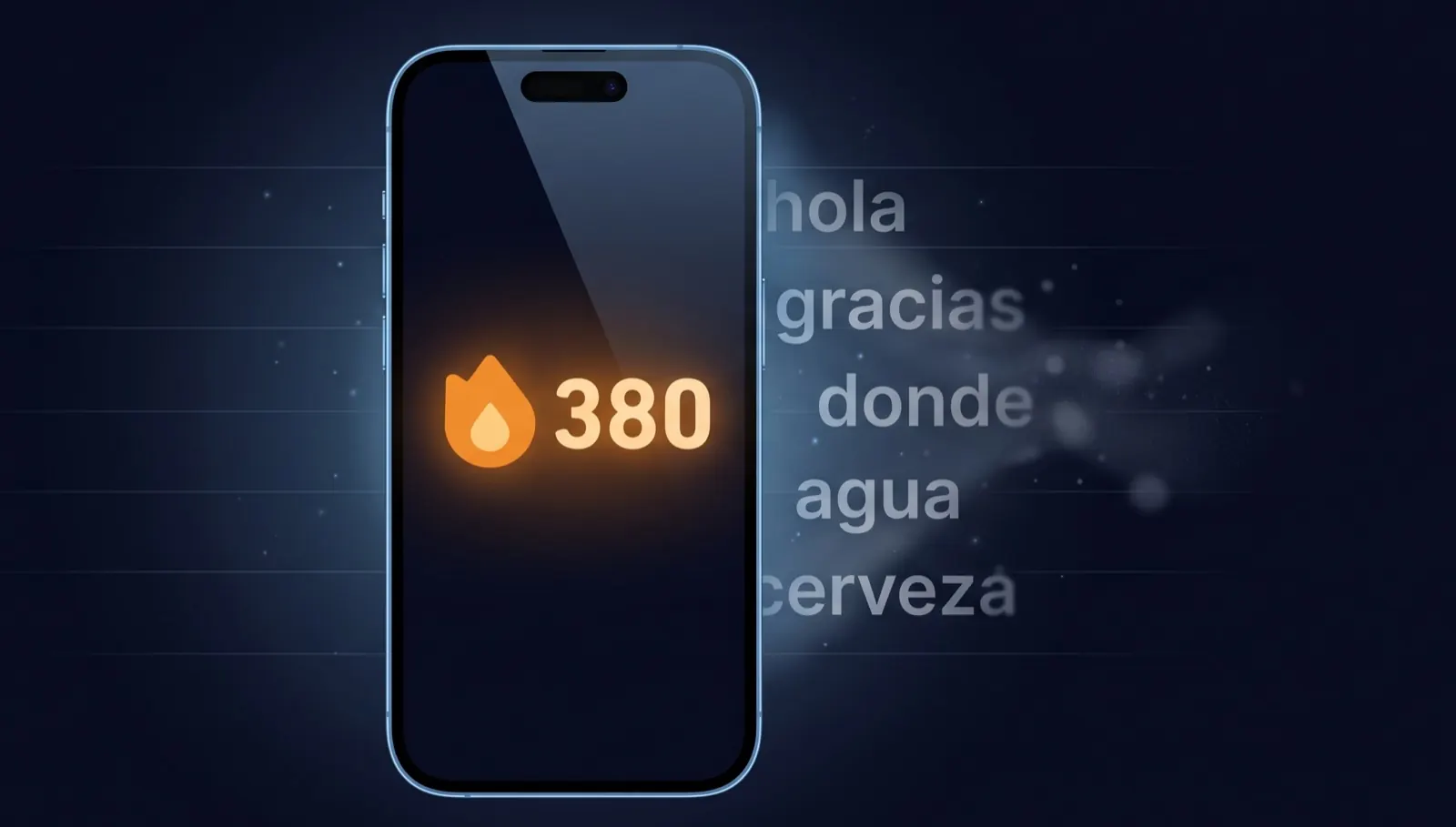
I used it for almost two years. I had a 380-day streak at one point. I genuinely tried to make it work.
And then I quit.
This post is about why - and why your experience might be similar even if you'd never describe yourself as anti-Duolingo.
The honest version of my experience
I started using Duolingo to learn Spanish about two years before a planned trip to Spain. I was disciplined. I did my daily lessons. I kept the streak going. I bought Super Duolingo at one point because I felt like I "should" support an app I was using daily.
After 18 months, I noticed something uncomfortable: I could complete Duolingo lessons fluently. I could not have a coherent conversation in Spanish. Not "rough conversation" - I mean I would freeze up at "where is the bathroom."
When I actually got to Spain and tried to order food, ask for directions, or chat with locals, my mental Spanish vocabulary was shockingly thin. Words I'd "learned" in Duolingo lessons wouldn't surface when I needed them. The phrases I could produce on demand were the bizarre hyper-specific ones the app drilled - "the elephant drinks milk", "my brother's cat is sleeping" - none of which I'd ever need to actually say.
This isn't a unique experience. Search "Duolingo doesn't really work" and you'll find thousands of people describing the same thing. The streak is intact. The lessons feel productive. The actual vocabulary retention is somehow much worse than expected.
I quit Duolingo, kept my Spanish goal, and tried to figure out what had gone wrong.
What I think actually went wrong
Looking back, three things stand out.
1. Gamification rewarded engagement, not learning
Duolingo's core engagement loop is the streak. Lose your streak, lose your progress identity. So you do the daily lesson - any daily lesson - to keep it alive.
This is psychologically brilliant for retention. It's why Duolingo has a 50% next-day return rate when most apps have under 5%. But it has a side effect: on tired days, I'd pick the easiest possible lesson to keep my streak going. Repeating phrases I'd seen a hundred times. Bouncing off lessons that felt slightly hard.
The streak rewarded me for showing up. It didn't reward me for stretching. So I optimized for showing up. The streak grew. My Spanish, in retrospect, didn't.
This isn't Duolingo's fault - it's how I used it. But the design encourages that exact pattern in a way that more boring apps don't.
2. The vocabulary content was weirdly impractical
Duolingo's sentences are famous for being slightly absurd. "The bear eats honey." "I am drinking milk." "Where is my dog?" The official explanation is that absurdity helps memory. There's some truth to this.
The downside, which I felt as soon as I needed real Spanish: vocabulary that's never used in real conversation doesn't get reinforced by real life. I never had occasion to discuss elephants drinking milk in actual Spain. So the words I'd drilled in Duolingo never came back into my brain through real-world exposure. They stayed pinned to that one weird sentence and never grew roots.
What I needed was the opposite: extremely common, useful vocabulary. Numbers. Greetings. Food terms. Travel words. Family. Verbs. The stuff you use within an hour of landing in a Spanish-speaking country.
3. The lessons were a destination, not part of my life
Duolingo lessons live inside the app. To learn, I had to:
- Notice the urge to learn
- Open my phone
- Open the app
- Do a lesson
- Close the app
Five steps, and only step 4 is actual learning. Most days I'd manage maybe one of these lesson sessions, twenty minutes at most. The remaining 23 hours and 40 minutes of my day, Duolingo was completely absent from my life.
For comparison: a single Instagram or TikTok session can consume an hour without me noticing. Why? Because those apps fit the gaps in my day. They're available in moments of micro-boredom. They don't require me to "make time."
I started thinking: what if vocabulary learning could fit into the gaps the same way?
What I tried before building something
Before deciding to build my own thing, I tried other tools to fill the gap Duolingo had left.
Anki - the spaced repetition gold standard. Algorithm: excellent. UI: a 1990s shareware nightmare. I bounced after a week not because Anki was bad but because looking at it made my brain shut down. (I respect Anki users immensely. I am not one of them.)
Drops - beautiful design, visual flashcards. I liked it. The 5-minutes-per-day free tier limit drove me away before I committed to a subscription, and the subscription was expensive enough that I never quite pulled the trigger.
Busuu - solid structured courses. Felt more like school. Lost interest after a few weeks for the same reason I lose interest in textbooks.
Memrise - good audio, friendly UI, reasonable pricing. The closest I got to a Duolingo replacement. But the lock-screen widget was an afterthought and I kept going back to forgetting the words anyway.
What I noticed: every one of these required me to schedule learning time. Open the app, do the thing, close the app. Just like Duolingo. The mechanic differed but the dynamic was the same.
What I actually wanted didn't exist: an app where I'd see vocabulary words without scheduling anything. Not in lessons. Not in reminders. In the moments I was already on my phone. Glancing at the lock screen for the time. Pulling down the notification shade. Looking at home-screen widgets.
So I started building it. That ended up being Wordify.
What I built differently
I'm not going to claim Wordify is "better than" Duolingo. It's a different product for a different problem. Duolingo wants to be the place where you learn a language. Wordify wants to be the layer that exposes you to vocabulary without ever asking you to "learn" anything.
The specific things I did differently:
- No lessons at all. Wordify doesn't have a course curriculum. It just has vocabulary collections (Travel, Numbers, Verbs, Adjectives, etc.) that you can train on with five different game modes if you want - or never, if you don't.
- No streaks as the primary engagement. There's a streak counter because users asked for one, but the app doesn't shame you for breaking it. The widgets keep working. The notifications keep working. You missing a day doesn't reset anything.
- Lock-screen and home-screen widgets are the core feature, not an afterthought. Most learning happens passively, by glancing at words throughout the day. Active training is optional reinforcement.
- The vocabulary is curated for usefulness, not absurdity. The Travel collection is words you'd actually use traveling. The Food collection is food you'd order. No bears, no honey-drinking elephants.
- You pick what to learn. Any collection, any subset, even your own custom words. No fixed course path you have to grind through to "unlock" the words you actually care about.
- It's affordable. A fraction of what Duolingo Plus costs - because I'm one developer with one app, not a billion-dollar company supporting 50+ language courses.
I'm not promising Wordify will work for you. Some people genuinely thrive with Duolingo's gamification. Others need structured courses. The point of this post isn't "use Wordify instead" - it's that if Duolingo isn't quite landing for you, the problem might not be your discipline. It might be that you need a fundamentally different shape of tool.
Five honest questions to ask yourself about Duolingo
If you're using Duolingo and quietly wondering if it's working as well as your streak suggests, here are the questions that helped me figure it out:
1. When you encounter your target language in real life - a podcast, a movie, a conversation - how much do you actually understand?
Duolingo lessons feel productive but lab-conditions productivity isn't real-world fluency. A 100-day streak doesn't translate directly to comprehension.
2. If you stopped using Duolingo for a month, would you remember most of what you learned this week?
Spaced repetition is supposed to push retention well past one week. If a few days off makes things slip away, the algorithm isn't doing its job.
3. Do you find yourself picking the easiest lesson available just to extend your streak?
That's the pattern I fell into. It's a sign the streak is driving behavior, not the learning.
4. Are the words and phrases you're learning the ones you'd actually need in real conversation?
Not "the elephant eats honey." "Where is the bus station." "I'd like a coffee, please." The boring stuff is the useful stuff.
5. When you're not in a Duolingo lesson, how often does your target language touch your life?
If the answer is "never except during lessons," that's the gap that passive learning tools - widgets, immersion, podcasts - are designed to fill.
If you answered honestly and felt some discomfort, you're not alone. Duolingo isn't broken. But it might not be the only tool you need, or the right tool for what you're actually trying to do.
Closing
I want to be clear about one more thing: I don't regret using Duolingo. It got me started. The 380-day streak built a habit of daily language exposure that I still have. Without that foundation, I might have given up on Spanish entirely.
But I outgrew it. Or maybe I never quite fit in the first place. Either way, I needed something different - and when I couldn't find it, I built it.
If your experience with Duolingo has been similar - productive on paper, less productive in real life - try a tool with a different philosophy. Wordify is one option (it's mine, so of course I'd suggest it). Drops, Memrise, Anki, Busuu are others. Even just listening to a podcast in your target language for 20 minutes a day is a different shape of tool that works for some people.
The right answer is probably not one app. It's a few tools that each do one thing well, used together.
Don't let a streak number convince you you're learning when you're not.
See also:
- How Wordify started - the backstory of building a vocabulary app for the gaps between lessons.
- Lock screen widgets that actually teach you something - an honest roundup of widget-based learning apps in 2026.
- How spaced repetition actually works - the algorithm a real SRS app uses, in plain English.
- 10 best Duolingo alternatives in 2026 - what to try instead, compared honestly.
Try the app
Vocabulary that comes to you
Through home screen widgets, lock screen widgets, and notifications. 7-day free trial. No account needed.