
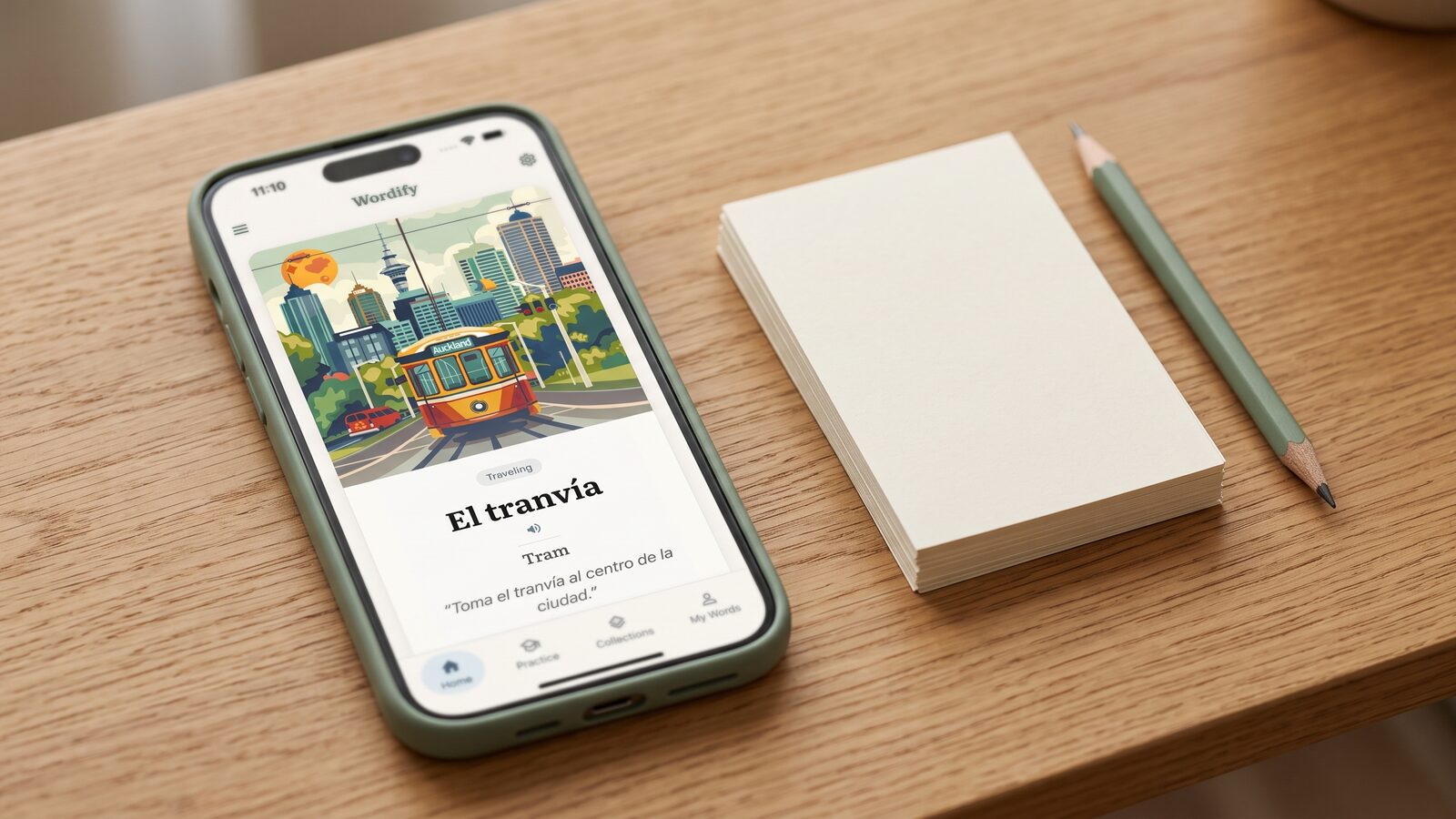
Most vocabulary advice is folklore. Write the word ten times. Read the list before bed. Highlight the important ones. These methods survive because they feel productive - and that feeling is precisely the problem, because memory research has spent a century showing that the techniques that feel easiest do the least.
The good news: the same research is unusually clear about what does work. Here's the ranking, the popular methods that quietly fail, and a simple daily system that combines the winners in about 15 minutes.
What works, ranked
1. Active recall: test yourself, don't re-read
The single most robust finding in learning science is the testing effect: retrieving a word from memory strengthens it far more than looking at it again. The struggle is the point - every time you force your brain to produce la manzana instead of just recognizing it, the memory trace gets physically stronger.
In practice this means flashcards done honestly (answer before flipping), covering the translation column of a list, or typing a word from memory. If a method never makes you feel that small moment of effort, it isn't recall, it's review theater.
2. Spaced repetition: review right before you forget
New memories decay on a predictable curve - steep at first, flatter after each successful review. Spaced repetition exploits this by scheduling each word's next review just before you'd forget it: after a day, then three, then a week, then a month. Each recall at the edge of forgetting roughly doubles how long the word survives.
The scheduling math is tedious to do by hand for hundreds of words, which is why software exists for it. I wrote a full breakdown in how spaced repetition actually works, including the mistakes most apps make with it.
3. Context: learn sentences, not word pairs
A word learned as an isolated pair ("Haus = house") is stored thin. The same word met inside "Das Haus ist alt" gets grammar, neighbors, and a scene attached to it - more hooks, more ways to retrieve it later. Context also teaches you what dictionaries can't: which words actually go together. You make a decision in English but take one in many other languages, and only sentences reveal that.
You don't need to memorize full sentences; just make sure every new word comes with at least one example you've actually read aloud.
4. Dual coding: attach an image
Pairing a word with a picture stores it in two systems - verbal and visual - and either one can later trigger the other. This is why picture-based matching feels easy and why concrete nouns are learned fastest. For abstract words, an image of a situation works almost as well as a literal picture.
5. Frequent ambient exposure
Repetition doesn't all have to be deliberate. Seeing your current words on a widget or lock screen dozens of times a day builds familiarity between study sessions - each glance is a micro-review that costs nothing. Passive exposure alone won't move a word into your active vocabulary (that still takes recall), but it dramatically reinforces what your reviews are building. This is the entire reason I built Wordify around lock screen and home screen widgets.
What doesn't work (but feels like it does)
Re-reading lists. The most popular method and the worst one. Recognition builds fast and creates an illusion of knowing - the words look familiar, so you feel done. Familiarity is not recall; the test comes in conversation, and conversation doesn't show you the list first.
Highlighting. Decades of studies on highlighting show little to no benefit. It marks words as important without making your brain do anything with them.
Cramming. Twenty repetitions tonight beat twenty repetitions spread over a month - for tomorrow's test. Two weeks later the spaced version wins by a landslide, and vocabulary is a two-year game, not a tomorrow game.
Pure passive listening. Podcasts and background audio are great for ears and rhythm, but words you've never deliberately learned mostly wash past. Input works as a multiplier on studied vocabulary, not a replacement for it.
A 15-minute daily system that combines the winners
Here's how the pieces fit together into something you can actually sustain:
- Add up to 10 new words from a frequency-based or themed list - words you'll actually use. (Why 10, and why frequency matters more than volume, is covered in how many words you need to speak a language.)
- Review everything due first, as honest recall - answer, then check. Due words always come before new words; the backlog is where learning actually happens.
- Read each new word's example sentence aloud once. Ten seconds per word, and it attaches context and sound.
- Let ambient exposure run between sessions - a widget, lock screen, or notification showing your current words, so the 50 daily glances at your phone quietly reinforce the morning's work.
That's the whole system. Wordify is my implementation of it - SM-2 spaced repetition doing the scheduling, five training modes ranging from recall-heavy flashcards and spelling to picture matching, example sentences and images on every word, and widgets handling the ambient layer - but the principles are tool-agnostic. A shoebox of paper flashcards run on these rules will beat the fanciest app used passively.
The uncomfortable summary: effective memorization feels slightly harder in the moment, because effort is the mechanism. Choose the methods that make you retrieve, space them out, and the words stop leaking.
Quick answers
What is the fastest way to memorize vocabulary?
Test yourself instead of re-reading, and space the tests out over days. Active recall plus spaced repetition is the most consistently proven combination in memory research - roughly 10 new words a day, with due words reviewed before new ones are added.
Why do I keep forgetting vocabulary words?
Because single exposures fade fast - without review, most of a new word's memory is gone within days. That's the forgetting curve, and it isn't a personal flaw. The fix is reviewing a word right before you'd forget it, at growing intervals, which is exactly what spaced repetition schedules for you.
Is writing words down a good way to memorize them?
Writing helps more than reading because it's slower and more effortful, but copying a word while looking at it is still weak. Writing from memory - covering the word and producing it yourself - turns it into active recall, which is what actually builds retention.
See also:
Try the app
Vocabulary that comes to you
Through home screen widgets, lock screen widgets, and notifications. 7-day free trial. No account needed.