

Around 1,000 words is enough to handle everyday conversation. Roughly 3,000 words covers about 95% of what you'll hear and read in daily life. Native speakers know somewhere between 15,000 and 20,000 word families, but you don't need anywhere near that number to communicate, and chasing it is one of the biggest mistakes language learners make.
Here's where those numbers come from, what they mean for your learning plan, and why which words you learn matters far more than how many.
Why so few words go so far
Language is astonishingly top-heavy. A small handful of words does most of the work, while tens of thousands of rare words sit in the long tail, appearing once in a blue moon.
Linguists have measured this on massive collections of real text and speech (called corpora), and the pattern holds across languages:
- The 100 most common words make up roughly half of everything said and written in everyday language. In English that's words like the, be, to, of, and, you, have: the connective tissue of every sentence.
- The 1,000 most common word families cover about 85% of ordinary spoken language.
- The 3,000 most common word families push coverage to around 95%.
After that, the curve flattens brutally. Going from 3,000 to 6,000 words might buy you a few extra percentage points of coverage. Researcher Paul Nation, whose work on vocabulary size is the standard reference in the field, estimates you need around 6,000 to 7,000 word families to understand 98% of casual spoken conversation, and each additional percent costs thousands of new words.
The practical takeaway: the first 1,000 words you learn are worth more than the next 10,000 combined. That's not motivational fluff; it's arithmetic.
(A quick note on "word families": learn, learns, learned, learning count as one word family, not four. Most vocabulary research counts families, and so do the numbers in this article.)
Vocabulary size by CEFR level
If you're studying toward a level, whether for school, work, citizenship, or an exam, here's how vocabulary size roughly maps onto the CEFR scale, the framework used across Europe to describe language ability:
| CEFR level | Approximate vocabulary | What it feels like |
|---|---|---|
| A1 | ~500 words | Introduce yourself, order food, survive as a tourist |
| A2 | ~1,000 words | Handle routine everyday situations and simple conversations |
| B1 | ~2,000 words | Talk about work, travel, opinions; watch familiar TV with effort |
| B2 | ~4,000 words | Comfortable conversation on most topics; read newspapers |
| C1 | ~8,000 words | Nuance, humor, professional contexts |
| C2 | ~16,000 words | Near-native range |
Two honest caveats. First, these numbers are approximations. Different researchers and exam boards publish somewhat different figures, and languages vary (a heavily inflected language packs more meaning into fewer word families than English does). Second, CEFR levels measure what you can do with a language, not just what you know. Vocabulary is the fuel, but you still have to drive.
Still, the shape of the table is the point: conversational ability lives at 1,000 to 2,000 words. That's a goal measured in months, not years.
The catch: which words matter more than how many
Here's where most learners go wrong. Knowing 1,000 words is only powerful if they're the right 1,000 words.
Learn 1,000 random dictionary entries, or 1,000 words from whatever topics happen to come up, and your real-world coverage will be far below 85%, because you'll have collected rare words while missing common ones. Plenty of learners can name fifteen animals and eight kitchen utensils but freeze when they need to say already, maybe, or enough.
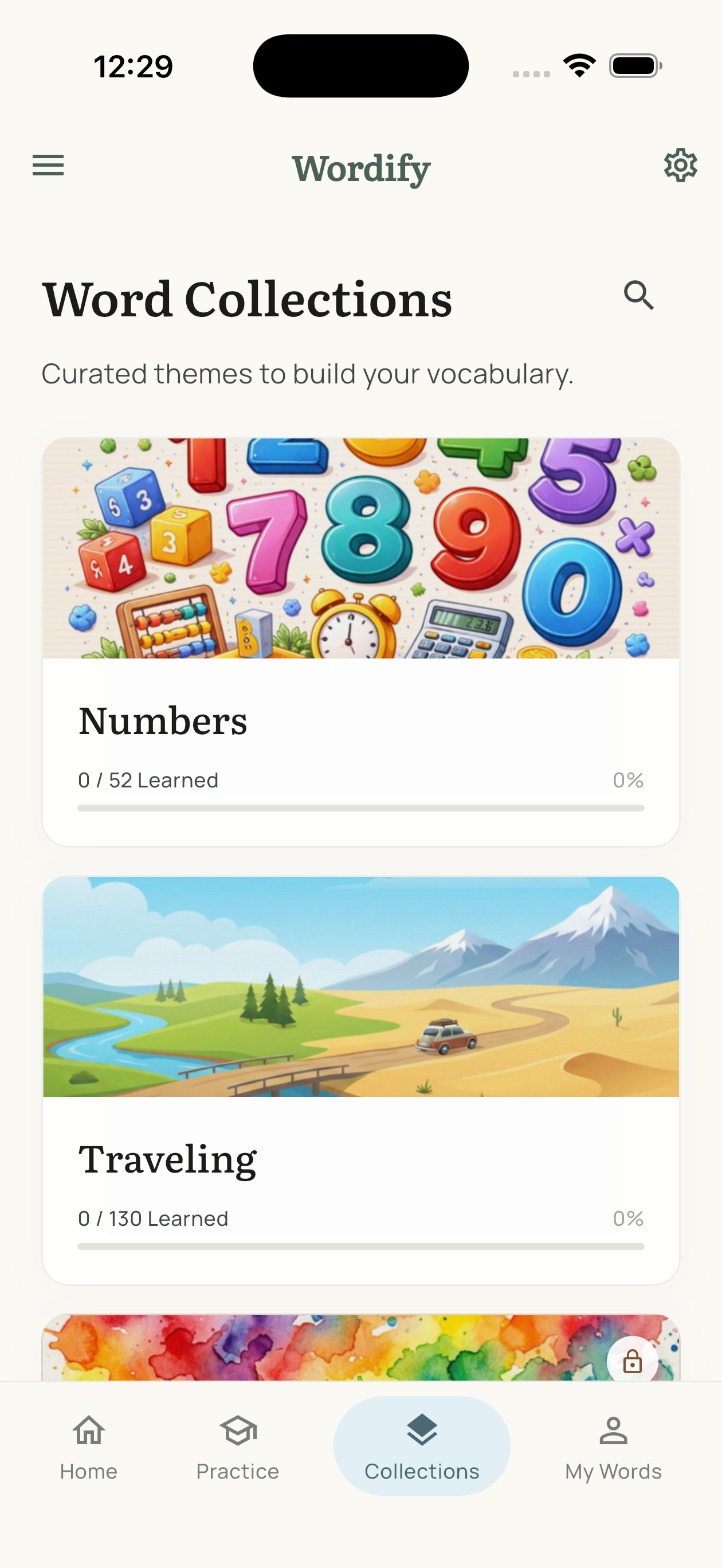
Frequency is the filter. High-frequency words and the vocabulary of situations you'll actually be in (greetings, time, numbers, food, travel, work) pay off immediately, every single day. A word like aardvark may be charming, but it will wait patiently for years before you ever need it.
This is also why vocabulary drills inside full course apps can feel slow: lessons introduce words in the order the curriculum needs them, not in the order of usefulness. (I wrote more about that in Why I stopped using Duolingo.) If your goal is to speak sooner, working directly from frequency-informed, themed word lists is the shortcut.
Passive vs. active vocabulary: why you "know" words you can't use
If you've ever thought "I know 2,000 words, so why can't I speak?", this is why.
Everyone has two vocabularies. Your passive vocabulary is the words you recognize when you hear or read them. Your active vocabulary is the smaller set you can actually produce in conversation, on demand, under time pressure. For learners the gap is often huge: passive vocabulary can easily be two or three times the size of active vocabulary.
The word counts in this article mostly describe passive knowledge, that is, understanding 95% of what you hear. Speaking fluently at a given level takes fewer words than that, but they have to be deeply known: retrievable in under a second, not "I'd recognize it if I saw it."
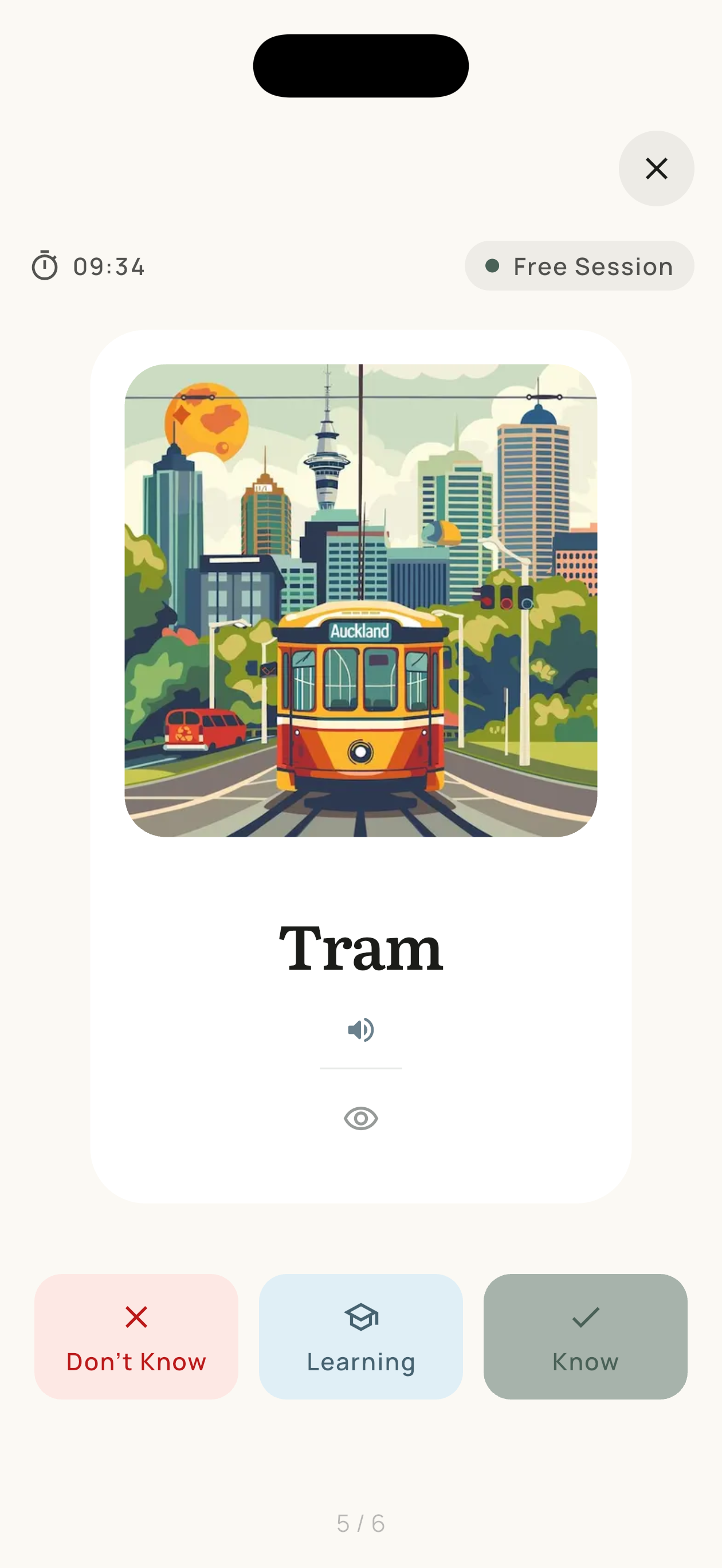
Moving words from passive to active is a repetition problem. You need to meet a word repeatedly, at increasing intervals, and be forced to recall it rather than just re-read it. That's exactly what spaced repetition is designed to do. I've written a full breakdown in How spaced repetition actually works, but the short version is: reviewing a word right before you'd naturally forget it is the most efficient known way to make it permanent.
How fast can you realistically get there?
Let's put the pieces together with simple math.
At 10 new words a day, an entirely realistic pace with short daily sessions, you reach:
- 500 words (A1 territory) in about 7 weeks
- 1,000 words (everyday conversation) in about 3 months
- 2,000 words (B1 territory) in about 7 months
Even a modest 5 words a day gets you to conversational vocabulary within half a year. The constraint isn't intelligence or talent; it's consistency and retention. Ten words a day is easy on day one. The challenge is that on day 90 you're learning 10 new words while keeping the previous 890 alive. Without a review system, old words quietly leak away as fast as new ones come in, which is why so many learners feel stuck around the few-hundred-word mark despite months of effort.
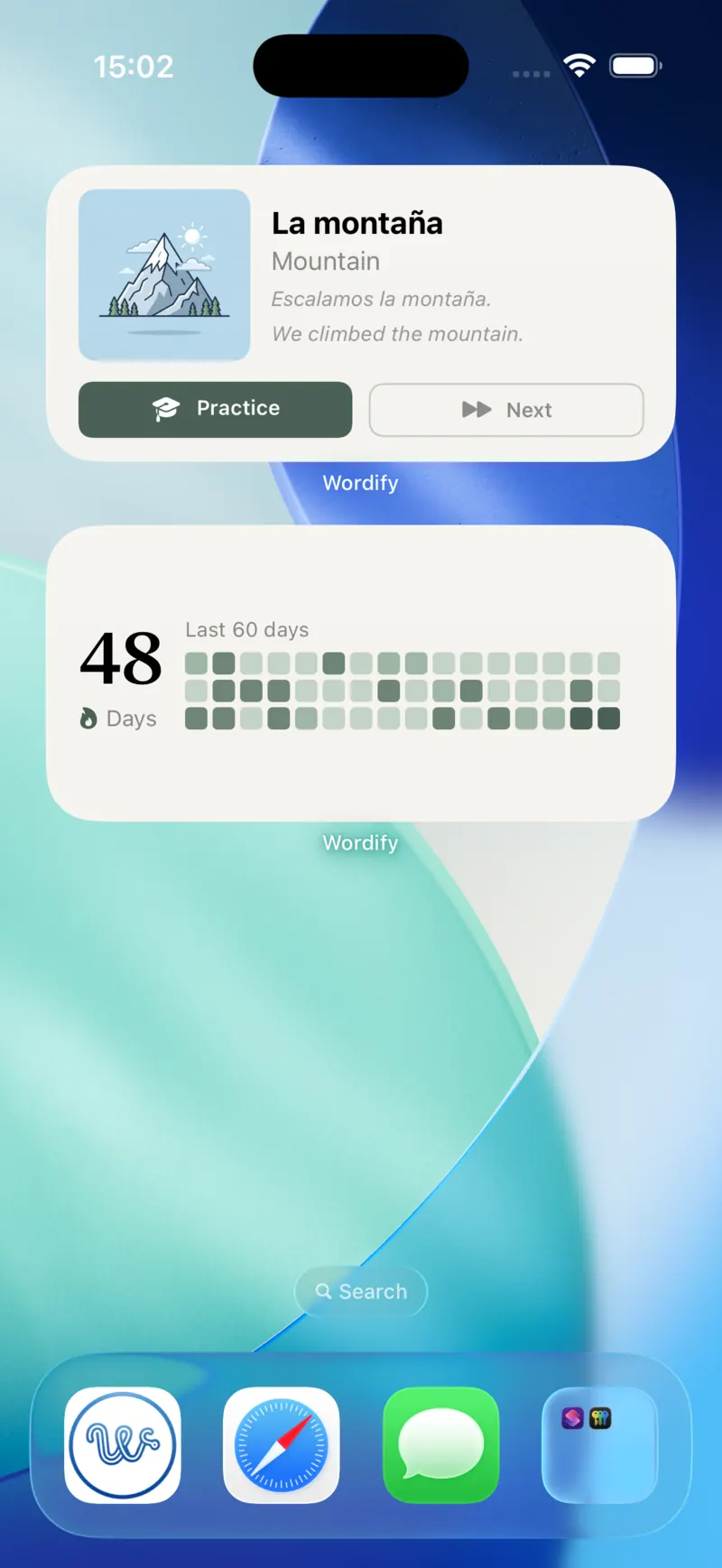
This is the part of vocabulary learning worth automating, and it's exactly what I built Wordify around. A spaced repetition system schedules each word's reviews for you, so nothing you've learned slips away unnoticed. Home screen and lock screen widgets keep your current words in front of you all day, which means a lot of the repetition happens passively, every time you glance at your phone, without opening an app at all. And to solve the consistency half of the equation, there's a streak heatmap widget: your day streak and a calendar of your recent practice, sitting right on your home screen. Watching an unbroken chain of green squares grow, and knowing a missed day would leave a visible gap, is a surprisingly strong reason to do today's five-minute review. Whatever tool you use, the principle is the same: pair a frequency-based word list with systematic review and a visible habit tracker, and the word counts above stop being abstract and become a calendar.
The bottom line
You don't need a native speaker's 20,000 words. You need about 1,000 well-chosen, well-practiced words to start having real conversations, and about 3,000 to be comfortable in daily life. Focus on high-frequency vocabulary, use spaced repetition so the words you learn actually stay learned, and the distance between "beginner" and "conversational" turns out to be about three months of ten words a day.
The question isn't really how many words. It's which words, and will you still know them next month? Get those two right and the number takes care of itself.
See also:
- How spaced repetition actually works — how the SM-2 algorithm decides when to show you each word, and where most apps cut corners.
- Why I stopped using Duolingo — a streak-based app vs. a spaced-repetition one.
- A streak widget and an adaptive heatmap — the home-screen habit tracker that keeps the daily review happening.
Try the app
Vocabulary that comes to you
Through home screen widgets, lock screen widgets, and notifications. 7-day free trial. No account needed.