
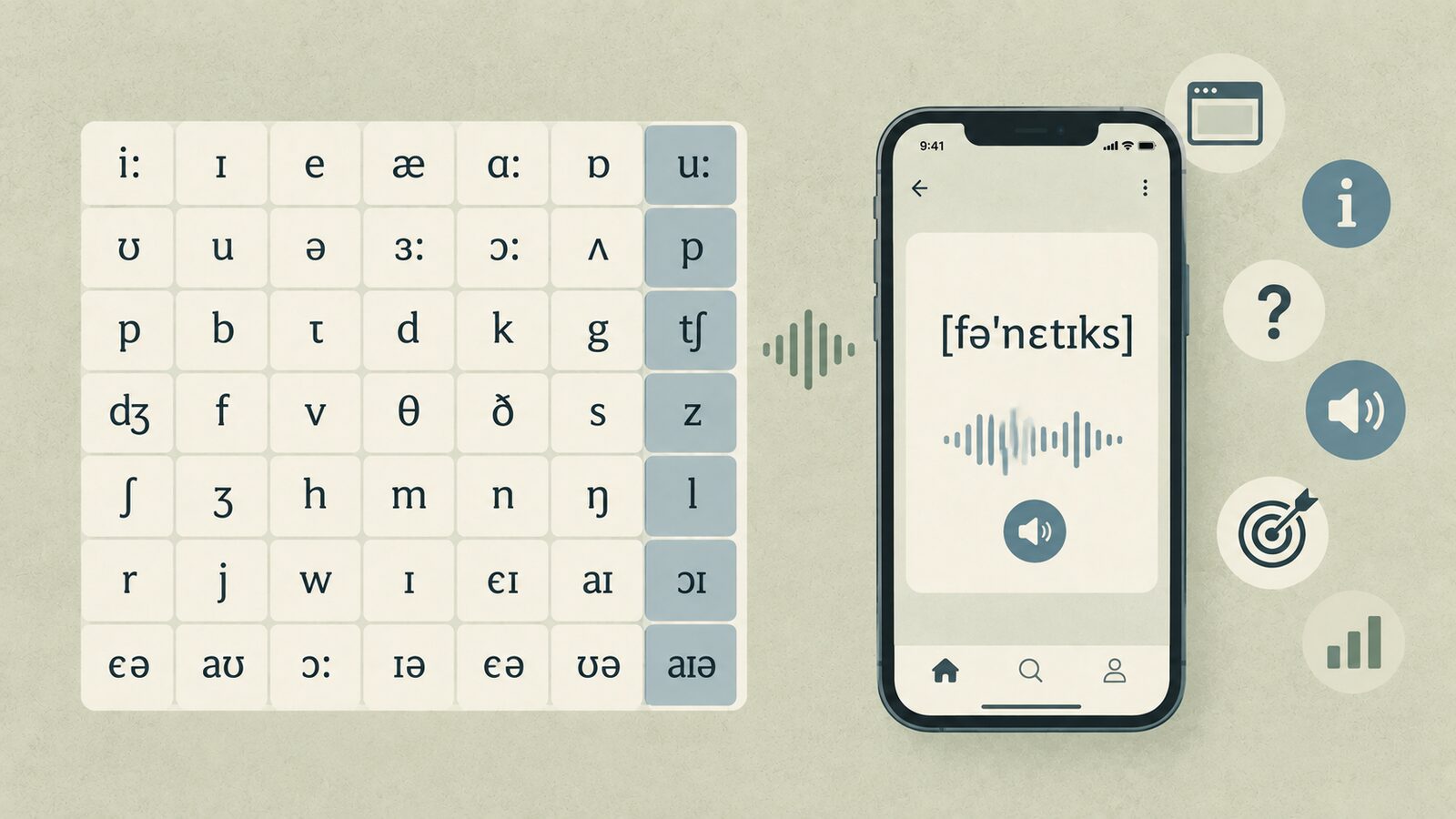
Open any good dictionary and you'll see something like /fɔːrθ/ next to the word "forth." Those slashes and strange letters are the International Phonetic Alphabet, and they exist because English spelling is a famously unreliable guide to how words actually sound.
The IPA makes one simple promise: one symbol, one sound, always. Once you know that /ʃ/ means the sh sound, it means that sound in every word, in every dictionary, in every language. Spelling can write that same sound as sh (ship), s (sugar), ti (nation), or ch (machine). The IPA doesn't play those games.
This page is the reference I wish I'd had when I started: every symbol you'll meet in English transcriptions, with example words and a plain-English note on how to make the sound. Bookmark it, and use the quick answers at the end for the symbols everyone asks about.
How to read IPA transcriptions
Three things before the charts:
- Slashes mark a transcription: /kæt/ is the pronunciation of "cat."
- The stress mark /ˈ/ comes before the stressed syllable: "banana" is /bəˈnænə/, stress on the middle.
- Dialects differ. This guide uses General American as the base and notes the biggest British (RP) differences where they matter. Neither is more correct; dictionaries usually show both.
Consonants
Most English consonant symbols look like the letters you already know and sound the way you'd guess: /p b t d k m n f v s z h w l/. Those need no explanation. The chart below covers everything, and the section after it walks through the symbols that trip people up.
| Symbol | Sounds like | Example words |
|---|---|---|
| /p/ | p in pen | pen, happy, stop |
| /b/ | b in bad | bad, rabbit, job |
| /t/ | t in tea | tea, better*, cat |
| /d/ | d in dog | dog, ladder, bed |
| /k/ | k in key | key, school, back |
| /ɡ/ | g in go | go, bigger, bag |
| /tʃ/ | ch in church | church, nature, catch |
| /dʒ/ | j in judge | judge, giant, bridge |
| /f/ | f in fall | fall, coffee, laugh |
| /v/ | v in very | very, never, love |
| /θ/ | th in think | think, author, bath |
| /ð/ | th in this | this, mother, breathe |
| /s/ | s in see | see, city, miss |
| /z/ | z in zoo | zoo, busy, dogs |
| /ʃ/ | sh in ship | ship, sugar, nation |
| /ʒ/ | s in vision | vision, measure, beige |
| /h/ | h in hot | hot, ahead, who |
| /m/ | m in man | man, summer, team |
| /n/ | n in no | no, dinner, sun |
| /ŋ/ | ng in sing | sing, think, tongue |
| /l/ | l in leg | leg, yellow, feel |
| /r/ | r in red | red, sorry, car** |
| /w/ | w in wet | wet, quick, one |
| /j/ | y in yes | yes, use, beyond |
* In American English, the t between vowels (better, water) often becomes a quick d-like flap, /ɾ/. Dictionaries still write /t/.
** In British RP, the r after a vowel (car, hard) is usually not pronounced; in American English it always is.
The consonant symbols people actually search for
/ʃ/ - the "sh" symbol. The sound in ship, sugar, nation, machine. Four different spellings, one symbol. If you remember a single IPA consonant, make it this one: it unlocks /ʒ/ and /tʃ/ too.
/θ/ and /ð/ - the two "th" symbols. English spelling writes both as th, but they're different sounds. /θ/ (theta) is voiceless: think, bath, author. /ð/ (eth) is voiced, with your vocal cords buzzing: this, mother, breathe. Test it with a hand on your throat - this vibrates from the first sound, think doesn't. Both are made with the tongue tip lightly between the teeth, which is why they're hard for speakers of the many languages that don't have them.
/ŋ/ - the "ng" symbol. One sound, not two. It's the ending of sing and ring, made at the back of the mouth like /k/ and /ɡ/ but through the nose like /n/. It also hides where spelling shows no g: think is /θɪŋk/, bank is /bæŋk/.
/tʃ/ and /dʒ/ - "ch" and "j". Technically two-symbol combinations, pronounced as single sounds: church /tʃɜːrtʃ/ and judge /dʒʌdʒ/. /dʒ/ covers every spelling of the j sound: giant, bridge, soldier.
/ʒ/ - the rarest English consonant. The buzzing middle sound of vision, measure, pleasure, and the end of beige. It's /ʃ/ with voice added.
/j/ - not the letter j. In IPA, /j/ is the y sound: yes /jes/, use /juːz/. The letter-j sound is /dʒ/. This one catches everyone at least once.
Vowels
Vowels are where English spelling truly falls apart - five letters trying to cover more than a dozen sounds - and where IPA pays off most.
Single vowels (monophthongs)
| Symbol | Sounds like | Example words |
|---|---|---|
| /iː/ | ee in see | see, team, police |
| /ɪ/ | i in sit | sit, busy, build |
| /e/ (/ɛ/) | e in bed | bed, said, friend |
| /æ/ | a in cat | cat, hand, laugh (US) |
| /ɑː/ | a in father | father, calm, lot (US) |
| /ɒ/ | o in lot (UK) | lot, want, watch |
| /ɔː/ | aw in law | law, thought, door |
| /ʊ/ | oo in foot | foot, good, put |
| /uː/ | oo in food | food, blue, through |
| /ʌ/ | u in cup | cup, love, blood |
| /ɜːr/ (/ɝ/) | ur in nurse | nurse, bird, work |
| /ə/ | a in about | about, banana, the |
Two notes. The pairs /iː/–/ɪ/ and /uː/–/ʊ/ differ in more than length: sheep /ʃiːp/ and ship /ʃɪp/ are different vowels, not a long and short version of the same one, and mixing them up is the classic learner giveaway. And /ɒ/ only exists in British English; Americans say lot with /ɑː/.
The schwa deserves its own paragraph
/ə/, the upside-down e, is the most common vowel sound in English. It's the lazy, neutral "uh" that almost any vowel letter turns into when its syllable is unstressed: the a in about, the o in lemon, the u in supply, both a's in banana /bəˈnænə/. If a word sounds nothing like its spelling, schwa is usually the reason. Learning to hear it - and to relax into it instead of pronouncing the written vowel - is the single biggest shortcut to natural-sounding English rhythm.
Diphthongs (gliding vowels)
These start as one vowel and glide into another, written as two symbols:
| Symbol | Sounds like | Example words |
|---|---|---|
| /eɪ/ | ay in day | day, make, break |
| /aɪ/ | y in my | my, time, buy |
| /ɔɪ/ | oy in boy | boy, coin, enjoy |
| /aʊ/ | ow in now | now, house, crowd |
| /oʊ/ (/əʊ/ UK) | o in go | go, home, know |
British transcriptions add a few more (/ɪə/ in near, /eə/ in square), where American English uses vowel + /r/ instead.
You don't need to memorize all of this
Here's the honest part: nobody sits down and learns 40 symbols from a chart. You learn IPA the way you learn vocabulary - a few symbols at a time, attached to real words, until reading /ˈneɪʃən/ feels as natural as reading "nation."
That's exactly why every word in Wordify shows its IPA transcription right under the spelling, in all 10 languages, next to the audio button. You hear the word, you see the symbols, and after a few weeks the chart above stops being a chart and becomes something you just read. I wrote more about that decision in why Wordify shows IPA phonetics - the short version is that spelling lies, audio fades from memory, and IPA is the only notation that tells you exactly what your mouth should do.
Start with five symbols: /ʃ/, /θ/, /ð/, /ŋ/, and /ə/. They cover the sounds English spelling hides worst, and they'll make every dictionary entry you ever read more useful.
Quick answers
What is the IPA symbol for the sh sound?
The sh sound is written /ʃ/ in IPA. You hear it in ship /ʃɪp/, sugar /ˈʃʊɡər/, and nation /ˈneɪʃən/ - note that spelling varies (sh, s, ti) but the symbol is always /ʃ/.
What is the IPA symbol for the th sound?
English has two th sounds. The soft, voiceless one in think and bath is /θ/. The buzzing, voiced one in this and mother is /ð/. Put your hand on your throat: /ð/ vibrates, /θ/ doesn't.
What is the IPA symbol for the ng sound?
The ng sound in sing and ring is a single symbol: /ŋ/. It's one sound, not n followed by g. The same sound hides inside think /θɪŋk/ and bank /bæŋk/, where the spelling shows no g at all.
What does the upside-down e (ə) mean in IPA?
That's the schwa, /ə/ - the relaxed 'uh' sound in unstressed syllables, as in about /əˈbaʊt/ and banana /bəˈnænə/. It's the most common vowel sound in English, which is exactly why so many words sound different from their spelling.
See also:
Try the app
Vocabulary that comes to you
Through home screen widgets, lock screen widgets, and notifications. 7-day free trial. No account needed.